@kidpro_india
 KhiladiPro
 @Khiladi-Pro
 kprosport.com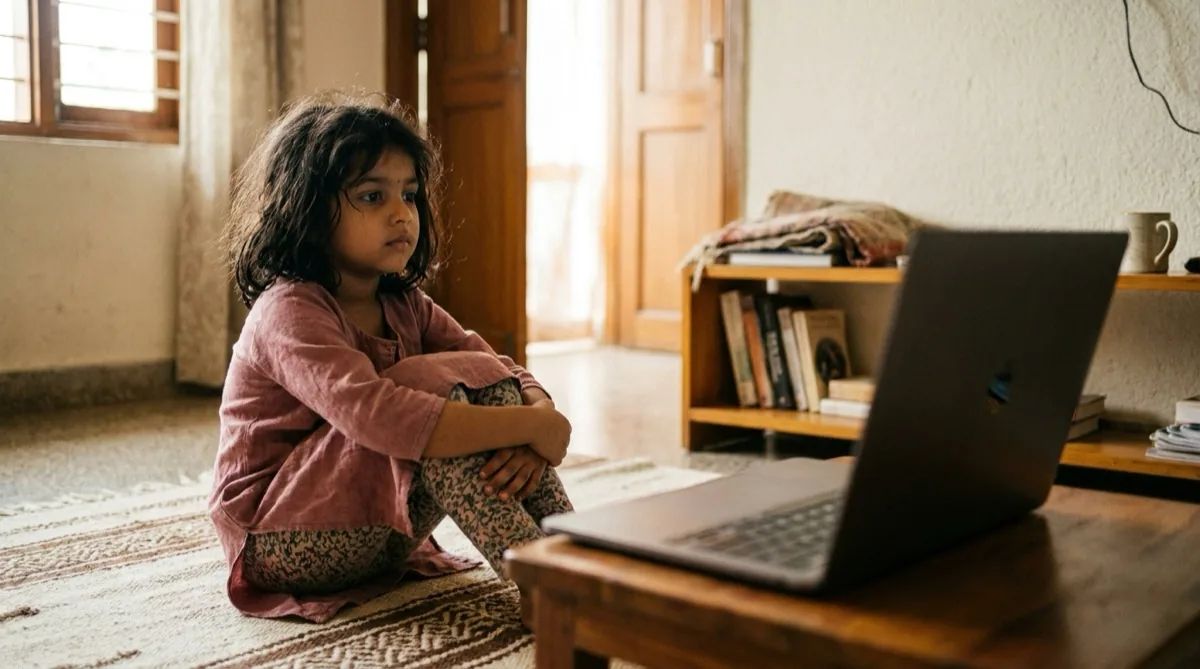
This is the question we are asked most often, and the answer surprises people: for a large share of shy children, an online class is easier than the in-person equivalent, not harder.
That is not a sales line. It follows from what actually makes a group hard for a quiet child.
What a hall does to a quiet child
Walk a slow-to-warm seven-year-old into a sports hall. Twenty other children, most of whom already know each other. Echo. A coach they must approach through a crowd. Nowhere to stand that is not visible. Parents watching from a bench. And the social task — insert yourself into a group mid-flow — has to be solved before any of the physical activity begins.
A shy child spends the first four sessions solving the social task. Some never get past it.
Now the same child on a screen, in their own living room. There is no crowd, because five other faces in a grid is not a crowd. There is no echo and no unfamiliar smell. There is no approaching anyone — the coach addresses them directly, by name, from the start. Their parent is in the next room. And crucially, there is a mute button.
The thing that helps most is not that the class is easier. It is that the social overhead is close to zero, so the child gets to spend their attention on the actual activity.
What to arrange before the first session
Six small things, and they matter more than anything that happens in the class itself.
- Tell the coach beforehand. A single message — "she takes a few weeks to warm up, please do not put her on the spot early" — changes how a good coach runs the first session. Most parents do not think to send it.
- Set the space up the day before. Same corner, same mat, camera at the child's height. Familiarity of place does a lot of the work.
- Let them watch the first one with the camera on and the mic off. Participation from the edge is participation.
- Be in the room, not in the frame. Present enough to be a safety net, not so present that the child performs for you.
- Do not commentate. The single most common mistake. "Look, do what he's doing!" turns a class into a test with a parent as examiner.
- Ask nothing afterwards except one open question. "What was the best bit?" beats "did you enjoy it?", which invites a one-word answer.
The four-session arc
Shy children tend to follow a recognisable pattern, and knowing it stops parents from calling it off in week two.
Session one. Watches. Does maybe a third of the movements, usually the ones that do not involve being looked at. Says nothing. This looks like failure and is not.
Session two. Does most of the movements. Still silent. May turn the camera slightly away. Normal.
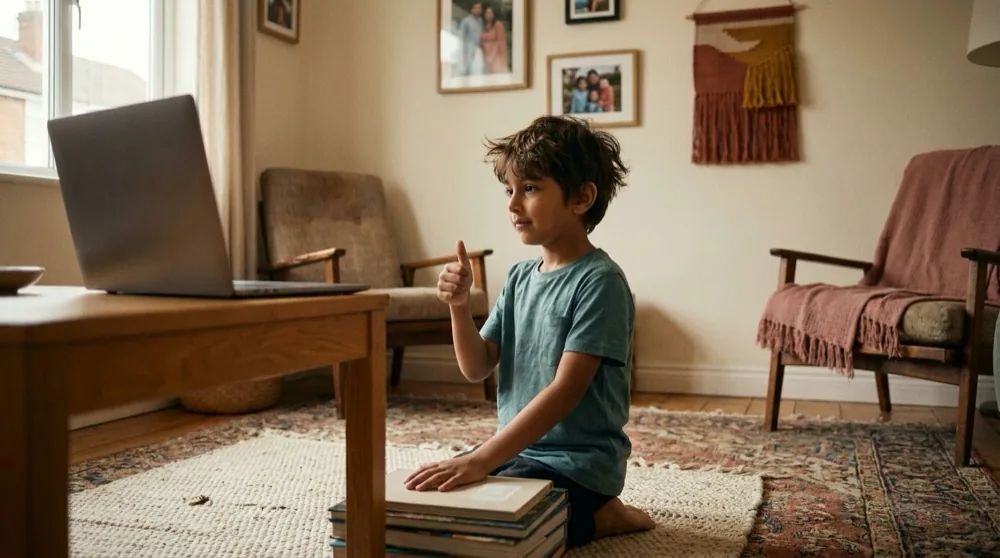
Session three. First unprompted response — often just a nod or a thumbs up when the coach uses their name. This is the turn.
Session four. Talks. Usually about something unrelated to the class.
If you are going to judge whether this works, judge it at session four, not session one.
What a coach should be doing
You are entitled to expect specific things from the coach, and they are easy to observe.
- Using your child's name early and often, without demanding a reply.
- Offering parallel options — "everyone pick hopping or jumping" — so a child can participate without being singled out.
- Never using a shy child as the demonstrator in the first few weeks.
- Noticing effort out loud rather than asking questions. "Nice soft landing, Aarav" requires no response; "Aarav, can you tell everyone how you did that?" requires a performance.
- Keeping the group genuinely small. Above eight, a quiet child disappears, and disappearing is very comfortable.
When it is not working
Be honest with yourself about the signs that this is the wrong format rather than a slow start:
- Distress before the session that gets worse across four or five weeks rather than better.
- Physical avoidance — hiding, tears, stomach aches on class days.
- A child who needs hands-on physical guidance to understand a movement cue. Some children genuinely do, and a screen cannot provide it.
Any of those, and the answer is an in-person option, ideally one-to-one to begin with. There is no virtue in persisting with a format because it is convenient for the adults.
One last thing
Shyness is not a problem to be solved. A quiet child who becomes a quiet child who can hop on one leg, land softly and hold a plank has had an entirely successful term. Confidence in this context means confidence in their own body, not volume.
KidPRO runs six children to a coach, live, for ages 4-12. If you message us about your child before the trial, the coach reads it before the session starts.