@kidpro_india
 KhiladiPro
 @Khiladi-Pro
 kprosport.com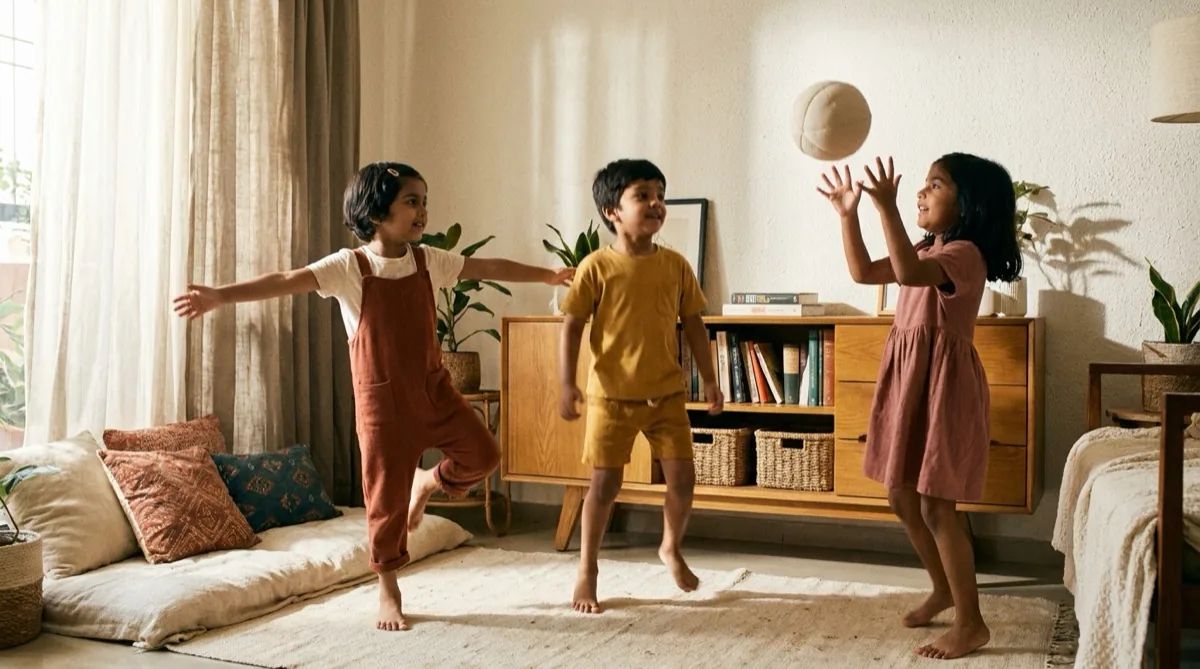
Fundamental movement skills are the alphabet of physical activity. Running, jumping, landing, hopping, skipping, throwing, catching, balancing, rotating. Every sport is a sentence made of them, which is why a child who is missing two or three letters struggles in every sport and nobody can work out why.
The window where these are most easily learnt runs from roughly age four to age eight. They remain learnable after that — this is not a deadline — but they take longer, and a child who has spent three years avoiding games because they are bad at them has a motivation problem on top of a skill problem.
What to expect, age by age
By age four
- Runs with a clear flight phase — both feet briefly off the ground.
- Jumps forward with two feet together and lands on two feet.
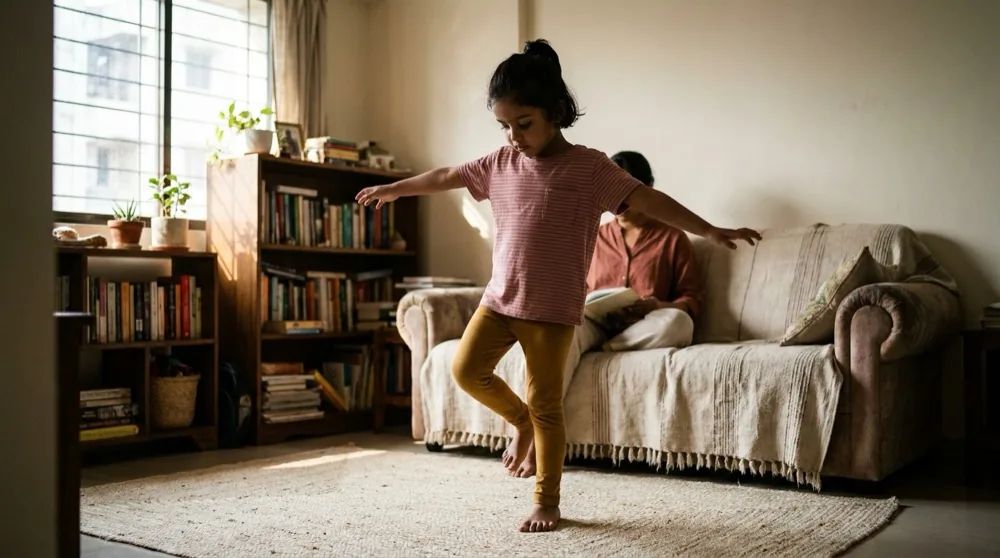
- Stands on one leg for about three seconds.
- Catches a large ball against the chest, arms straight.
- Climbs a low structure with alternating feet.
By age six
- Hops five times on one leg, then the other.
- Gallops and, by the end of this window, skips.
- Catches a bounced ball with hands rather than trapping it against the body.
- Throws overarm with the opposite foot forward and a visible trunk rotation.
- Balances on one leg for about eight seconds, eyes open.
By age eight
- Lands from a jump with knees tracking over toes and no audible thump.
- Changes direction at speed without slowing to a near-stop.
- Skips with a rope, continuously, ten or more times.
- Catches a ball on the move.
- Holds a single-leg balance for about twenty seconds, and can manage a few seconds with eyes closed.
If a child is a year or more behind on two or more of these, it is worth structured attention. One skill lagging is usually just lack of exposure.
A five-minute test you can run at home
Do this on a Sunday, make it a game, and do not tell your child it is an assessment. Score each as comfortable, wobbly, or cannot yet.
- Single-leg stand. Both legs, eyes open, count the seconds. Then eyes closed. Large differences between left and right matter more than the absolute number.
- Ten hops, each leg. Watch whether the hopping leg's knee collapses inward.
- Broad jump and freeze. Jump forward as far as they can and hold the landing for three seconds. You are watching the landing, not the distance. A soft, held, knees-out landing is the goal; a thump, a stumble or a collapse inward is the finding.
- Bounce catch. Bounce a tennis ball to them from three metres. Hands, not chest.
- Bear crawl, five metres and back. Hands and feet, knees hovering just off the floor. Watch for a sagging middle or knees dragging.
Five minutes. Write down what you saw. Repeat in eight weeks.
What the common gaps usually mean
Poor landing mechanics. By far the most common finding, and the one with the clearest consequence. A child who lands stiff-legged with knees falling inward is a child who will turn an ankle or strain a knee the first time they play competitively. This is highly trainable — a few weeks of deliberate jump-and-hold practice changes it.
Cannot skip by seven. Skipping needs alternating, cross-body coordination, and it is the skill most affected by a childhood with little free play. Its absence is a decent proxy for overall coordination.
Catching with the chest at seven. Usually a tracking issue rather than a hands issue — the child is not following the ball far enough in. Slow, large, close throws fix it faster than fast, small, distant ones.
Left-right asymmetry. A child who balances for twenty seconds on the right and five on the left is not "left-handed about it". Asymmetry that large is worth training out deliberately, with extra volume on the weaker side.
What to do about a gap
The treatment is boring and it works: short, frequent, specific practice. Ten minutes, four or five days a week, on the two or three skills that came back wobbly — not a broad "more exercise".
Three things make the difference between practice that moves a skill and practice that does not:
- Specificity. If landing is the gap, practise landing. Running around does not fix landing.
- Feedback. The child needs to be told what changed, every session. Without it they will practise the compensation rather than the skill.
- Volume over intensity. Forty soft landings across a week beats one exhausting session.
None of this needs equipment, a ground, or more than two square metres of floor. It does need someone watching closely enough to see the knee collapse — which, for most of these skills, is the actual bottleneck rather than the child's ability.
KidPRO's sessions are built around exactly these fundamentals, with a coach watching six children at a time. If you ran the five-minute test above and something came back wobbly, bring the result to a trial session and we will build from it.