@kidpro_india
 KhiladiPro
 @Khiladi-Pro
 kprosport.com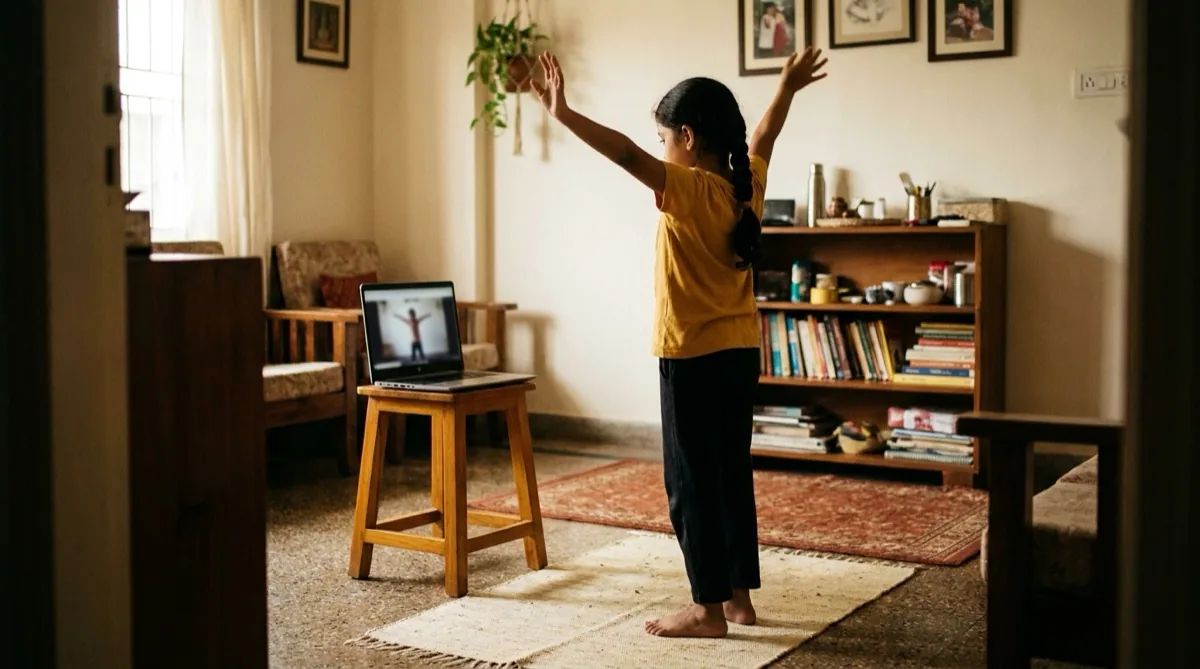
It is a fair question and it deserves a fair answer, including the parts that do not favour us.
Online fitness coaching for children works, reliably, under three conditions. Remove any one of them and the results fall off a cliff. Most of the scepticism parents bring to this question comes from having seen the version with the conditions removed.
Condition one: it has to be live
A pre-recorded video is a demonstration. A live class is coaching. The difference is not production value — it is the correction loop.
When a seven-year-old does a squat, they will almost always do three things wrong: knees fall inward, heels lift, and the chest drops. A video cannot see any of that. A coach watching on camera sees it in the first repetition and fixes it in the second. Over a term, that is the difference between a child who has practised a squat four hundred times and a child who has practised a bad squat four hundred times.
A recorded class teaches your child what the movement looks like. A live class teaches your child what the movement feels like when it is right.
Children under about ten are also poor at self-assessment. They are not being careless; the internal sense of where your limbs are in space is still developing. They genuinely cannot tell that their knee collapsed. Someone has to tell them, in the moment, every time, until they can feel it themselves.
Condition two: the group has to be small
There is a hard ceiling on how many children one coach can actually see on a screen. Past roughly eight, the coach is running a broadcast and calling out generic cues. Past twelve, they cannot reliably say who is in the room.
Small groups also do something a one-to-one session does not: they supply peers. Children work harder when other children are working, and a child who is bored is a child who is not coming back next week. The sweet spot most coaches converge on is somewhere between four and eight.
Condition three: it has to be built for the child's actual space
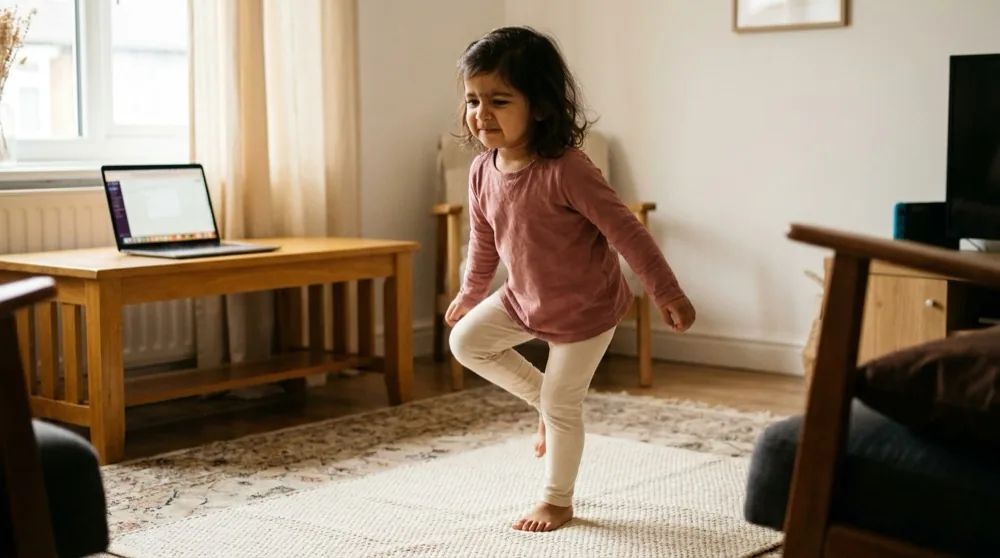
A session designed for a gym floor and then streamed into a flat is a session most families cannot do. The good online programmes are designed the other way around — two square metres, bodyweight only, no equipment beyond what a household already has, and no movement that requires running more than three steps.
This constraint turns out to be a feature. The movements that fit in two square metres — crawling patterns, jumping and landing, balance holds, rotations — are precisely the fundamental movement skills that most Indian children are behind on, because they are the ones a school sports period assumes you already have.
What online coaching does well
With those three conditions met, here is what parents can reasonably expect over a term:
- Consistency. No travel means no cancelled sessions for traffic, rain or a parent's meeting overrunning. Attendance rates for live online classes run far above the same family's attendance at an academy twenty minutes away.
- Fundamental movement skills. Running form, jumping and landing, balance, coordination, rotation. These are trainable and they respond fast at these ages.
- Strength through range. Bodyweight work through full ranges of motion — the thing a child who sits for nine hours a day is most short of.
- Focus and self-regulation. Following a sequence, waiting a turn, finishing a set when it stops being fun. Parents report this transfer more than any physical change.
- A parent who can see the session. You are in the next room. You know what your child did, and you can tell whether the coach is any good. That is not possible when you drop them at a gate.
What it does not do
It is worth being straight about the limits.
- It does not replace sport. Online coaching builds the athlete; a sport builds the player. A child who wants to play cricket still needs to play cricket, with a ball, on a ground, against other children.
- It does not teach contact or team tactics. Anything requiring another body — tackling, marking, passing under pressure — is out of scope.
- It will not work at all for some children. A child who cannot tolerate a screen-mediated instruction, or who needs physical guidance to understand a cue, will do better in person. A trial session will tell you which kind of child you have within about fifteen minutes.
How to judge a class in one session
If you are trialling something, watch for four things:
- Does the coach use your child's name, unprompted, within the first ten minutes?
- Does your child get a specific correction — not "good job", but "push your knee out"?
- Is the session structured — warm-up, skill, game, cool-down — or is it a sequence of exercises?
- Does your child volunteer anything about it afterwards without being asked?
That fourth one is the real test. A child who describes the class unprompted will attend the next twenty.
KidPRO runs live sessions of six children to one coach, forty-five minutes, for ages 4-12. The first one is a ₹99 trial, largely so you can apply the four tests above to us before deciding anything.