@kidpro_india
 KhiladiPro
 @Khiladi-Pro
 kprosport.com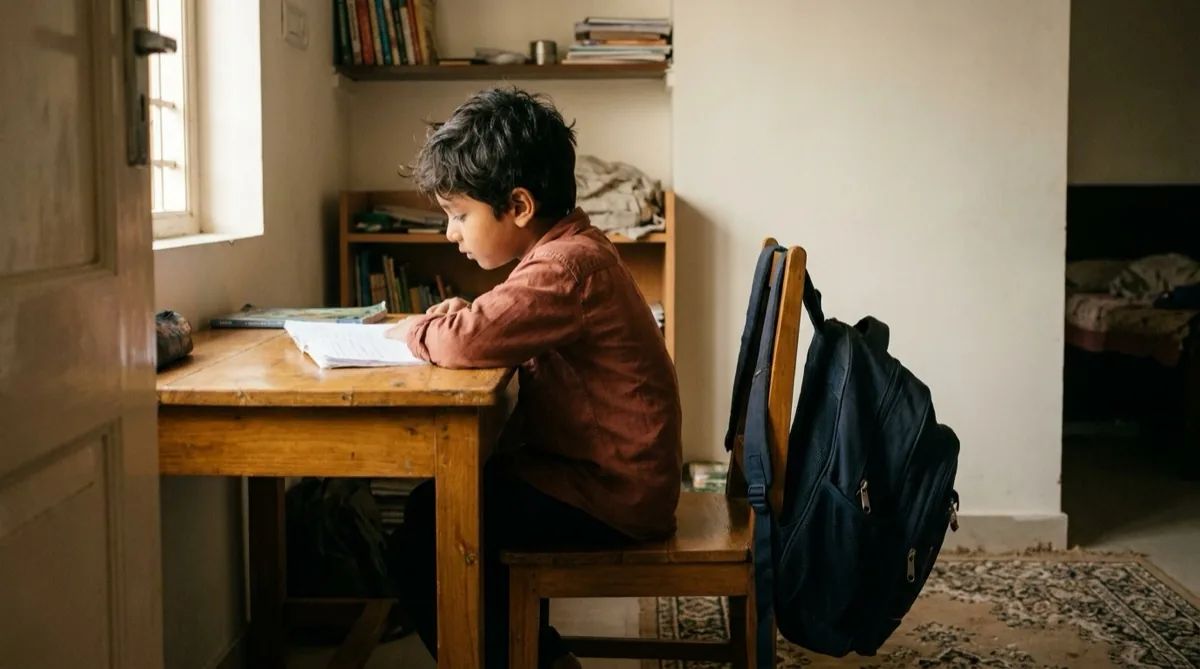
Every parent has said it. Sit up straight. Shoulders back. Head up. And every parent has watched it hold for about eleven seconds before the spine folds back into its comfortable C.
That is not defiance and it is not carelessness. Holding an upright position requires the muscles between the shoulder blades and along the back of the neck to work continuously, and in a child who spends nine hours a day seated, those muscles are simply not strong enough to do it for long. Telling them to sit up straight is asking for a plank from someone who cannot yet hold one.
What is actually happening
A typical Indian school day for an eight-year-old: six hours in a classroom chair, an hour of commute, two hours of homework, and some amount of screen time, most of it looking down.
Three things follow from that.
The front tightens. Chest muscles and hip flexors spend the day shortened. Shortened muscles pull.
The back weakens. The mid-back and deep neck muscles spend the day switched off. Muscles that are not used get weaker at it.
The head goes forward. A head weighs four to five kilograms in neutral. Tilted thirty degrees forward to look at a phone or a notebook, the effective load on the neck roughly triples. Children hold that position for hours.
Posture is not a thing your child is doing wrong. It is a thing their day is doing to them, and the fix has to address the day.
The school bag, specifically
The commonly cited guideline is that a school bag should not exceed ten to fifteen percent of a child's body weight. A 25 kg seven-year-old should therefore be carrying under about 3.5 kg. Weigh the bag once — most parents are startled.
Beyond weight, three things matter and cost nothing to fix:
- Both straps. One-strap carrying forces a lateral compensation the child then holds all day.
- Straps tightened so the bag sits high, its bottom at the waist rather than the hips. A low-slung bag pulls the shoulders back and the child compensates by pushing the head forward.
- Heaviest books closest to the spine. Load far from the body has more leverage on it.
The screen setup, specifically
You cannot remove the screen, so change the geometry.
- Raise the device to eye level. A stack of books under a laptop is a complete solution. The neck angle is the entire problem.
- Feet flat on the floor. If they dangle, put a box under them. Dangling feet mean no base, and no base means the spine does the stabilising.
- Screen an arm's length away. Closer pulls the head forward.
- The twenty-minute stand. Not a stretch, not a lecture — just stand up. Twenty seconds. The posture reset is automatic.
The strength half: five minutes a day
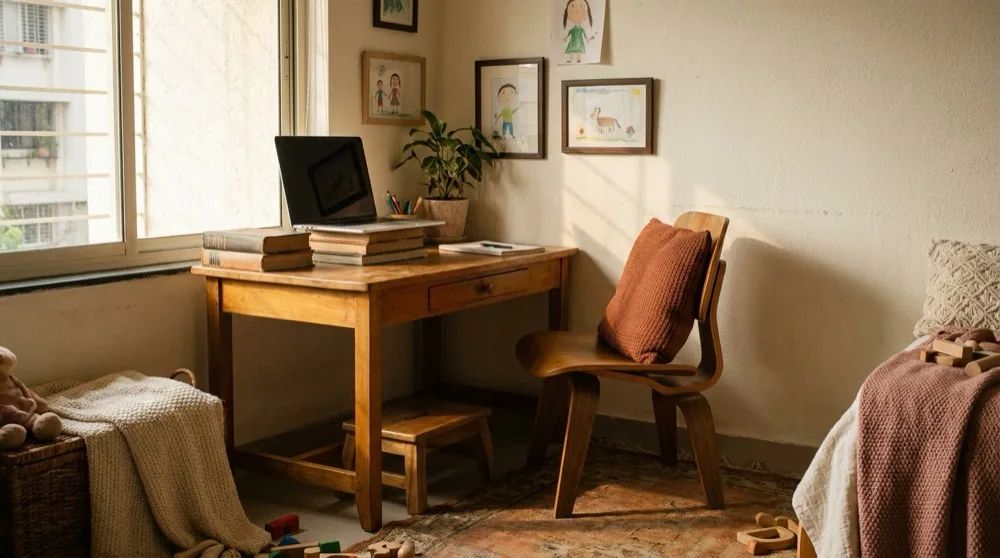
The setup changes remove the load. They do not build the capacity. For that, five minutes, daily, of work aimed at the back of the body:
- Wall angels. Back against a wall, arms in a goalpost, slide up and down keeping wrists and elbows touching the wall. Ten slow repetitions. This will be hard, and how hard tells you how much it was needed.
- Prone Y-holds. Lying face down, arms overhead in a Y, lift the chest and arms two inches and hold for five seconds. Eight repetitions.
- Bear crawl. Five metres forward, five back. Loads the shoulders and the deep trunk at once.
- Chin tucks. Sitting tall, draw the chin straight back — a double chin, not a nod. Hold three seconds, ten times. This directly counters the forward-head position.
- Doorway chest stretch. Forearm on the frame, step through, thirty seconds each side. This is the only stretch on the list, and it is here because the chest is the thing that is genuinely short.
Do them in that order. The whole set is under five minutes and needs no equipment.
What to expect, and when
Nothing visible for about two weeks. Around week three most parents notice the child holding upright for longer before folding — the fold is still coming, it is just later. Somewhere between six and ten weeks, the default resting posture changes, which is the actual goal. Reminders stop being necessary because the position stops being effortful.
One caution worth stating plainly: if your child has pain — neck, back, or shoulder — that persists for more than a couple of weeks, or any numbness or tingling, this routine is not the answer. See a paediatrician or a physiotherapist first. Posture work is for a slouch, not for a symptom.
Every KidPRO session opens with postural work, because it is the gap almost every child who joins us has. Sessions run live, forty-five minutes, ages 4-12.